Begin of page section:
Page sections:

  • Go to contents (Accesskey 1)
  • Go to position marker (Accesskey 2)
  • Go to main navigation (Accesskey 3)
  • Go to sub navigation (Accesskey 4)
  • Go to additional information (Accesskey 5)
  • Go to page settings (user/language) (Accesskey 8)
  • Go to search (Accesskey 9)

End of this page section. Go to overview of page sections

Begin of page section:
Page settings:

English en
Deutsch de
Search
Login

End of this page section. Go to overview of page sections

Begin of page section:
Search:

Search for details about Uni Graz
Close

End of this page section. Go to overview of page sections


Search

Begin of page section:
Main navigation:

Page navigation:

  • University

    University
    • About the University
    • Organisation
    • Faculties
    • Library
    • Working at University of Graz
    • Campus
    Developing solutions for the world of tomorrow - that is our mission. Our students and our researchers take on the great challenges of society and carry the knowledge out.
  • Research Profile

    Research Profile
    • Our Expertise
    • Research Questions
    • Research Portal
    • Promoting Research
    • Research Transfer
    • Ethics in Research
    • Commission for Scientific Integrity
    Scientific excellence and the courage to break new ground. Research at the University of Graz creates the foundations for making the future worth living.
  • Studies

    Studies
    • Prospective Students
    • Students
  • Community

    Community
    • International
    • Location
    • Research and Business
    • Alumni
    The University of Graz is a hub for international research and brings together scientists and business experts. Moreover, it fosters the exchange and cooperation in study and teaching.
Topics
  • Sustainable University
  • Researchers answer
  • Work for us
Close menu

End of this page section. Go to overview of page sections

Begin of page section:
You are here:

University of Graz Climate Change news Gewichtige Gemeinschaft: die Schlüsselrolle von Bodenkrusten im Erdsystem
  • About us
  • Research fields
  • Study/Doctorate
  • Network
  • Open Calls

End of this page section. Go to overview of page sections

Thursday, 07 May 2026

A substantial community: the key role of soil crusts in the earth system

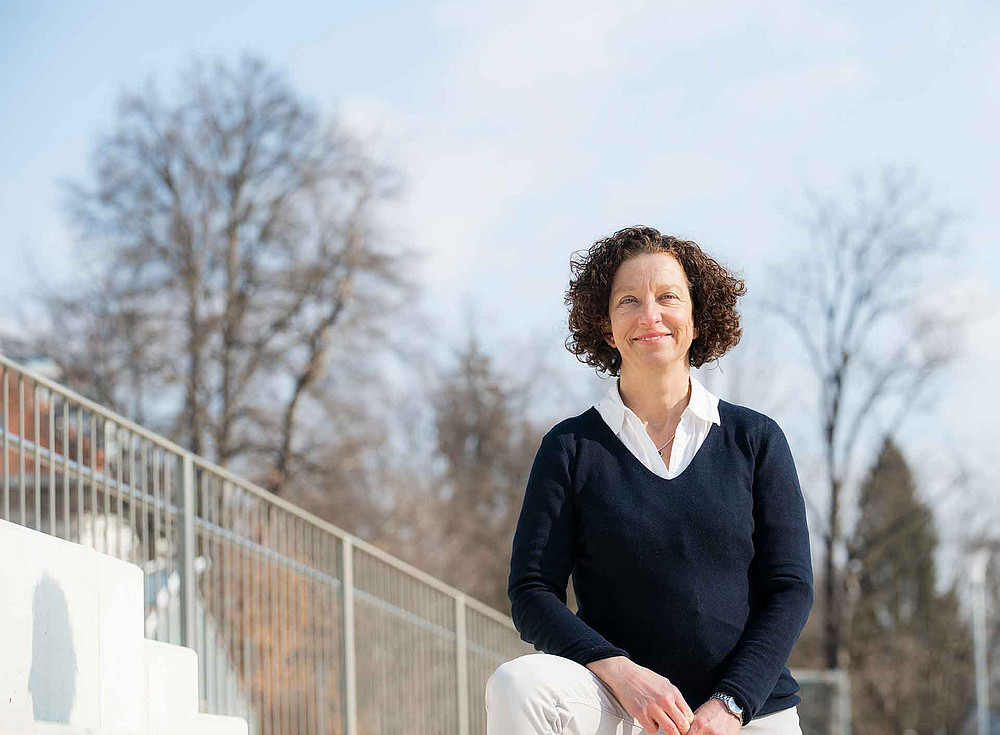
Bettina Weber ©Uni Graz/Tzivanopoulos

Bettina Weber rückt die Bedeutung von Bodenkrusten ins Licht. Uni Graz/Tzivanopoulos

They are often overshadowed by the plant world: lichens, fungi, mosses and bacteria, which form unique communities on rocks and trees or as soil crusts. Bettina Weber from the University of Graz is bringing this biological alliance into the research spotlight. Her research shows that these communities form an essential part of the Earth’s critical zone and play a key role in the interactions between land and atmosphere. Bettina Weber was honoured by the European Geosciences Union for her groundbreaking research at the beginning of May.

Bettina Weber describes the so-called cryptogam communities—comprising mosses, lichens, fungi, cyanobacteria and other bacteria—as “hidden beauties”. Her interest in them had already taken hold whilst she was studying at the University of Würzburg. “Many people asked me what the point of it all was. That drove me to investigate the significance of these miniature communities in globally relevant processes,” recalls the professor at the Institute of Biology at the University of Graz. A particular focus of her work is on biological soil crusts, which are substantial primarily in arid regions, but also in Arctic and high-alpine regions. As part of her research, Bettina Weber has produced the first and so far only global distribution map for soil crusts. They cover around twelve per cent of the Earth’s surface worldwide. In arid regions, they account for as much as a third. The largest areas are found in Africa, Asia, Australia and the Midwestern United States. These communities stabilise the soil, have a natural fertilising effect and thereby protect against desertification.

In her work, Bettina Weber has shown that cryptogam communities play a significant role in the global nitrogen cycle. This is due, on the one hand, to their importance in natural nitrogen fixation, but also, on the other hand, to the release of climate-relevant compounds of the element. Furthermore, her studies have shown that soil crusts effectively prevent the release of desert dust, thereby fulfilling a vital role for the climate and human health. Bettina Weber therefore warns against their disappearance: “Climate change and increasing land use are threatening soil crusts, meaning that up to 40 per cent could be lost by 2070.” For this reason, raising awareness of the importance and conservation of these biological communities, both in school classrooms and among relevant stakeholders such as farmers and conservationists, represents another aspect of her work.

“Bettina Weber is shaping research into biocrusts and cryptogam communities and exerting a lasting influence on global environmental science,” stated the European Geosciences Union, which brings together around 20,000 scientists worldwide. It awarded Weber the Alina Kabata-Pendias Medal at its annual meeting on 5 May 2026 in Vienna.
created by Andreas Schweiger

Related news

Workshop: Sermilik Station in an Arctic Perspective

A three-day workshop from 27 to 29 May 2026 on the future of research at Austria’s only Arctic field station held at the Institute of Geography and Spatial Research (Heinrichstraße 36, 8010 Graz)

Nachruf - Dagmar Henner 1969–2026

Der Profilbereich Climate Change Graz trauert um Dagmar Henner, die am 23.04.2026 unerwartet verstorben ist. Unser aufrichtiges Mitgefühl gilt ihren Hinterbliebenen und wir werden Dagmar in dankbarer Erinnerung behalten.

Interdisciplinary Conference - "A Relational World?"

UNIZEIT - Gesetze, um die Welt zu schützen

Der Jurist Oliver Ruppel befasst sich in einem seiner Forschungsschwerpunkte mit rechtlichen Herausforderungen, die der Klimawandel weltweit an Politik, Wirtschaft und Gesellschaft stellt.

Begin of page section:
Additional information:

University of Graz
Universitaetsplatz 3
8010 Graz
Austria
  • Contact
  • Web Editors
  • Moodle
  • UNIGRAZonline
  • Imprint
  • Data Protection Declaration
  • Accessibility Declaration
Weatherstation
Uni Graz

End of this page section. Go to overview of page sections

End of this page section. Go to overview of page sections

Begin of page section:

End of this page section. Go to overview of page sections