


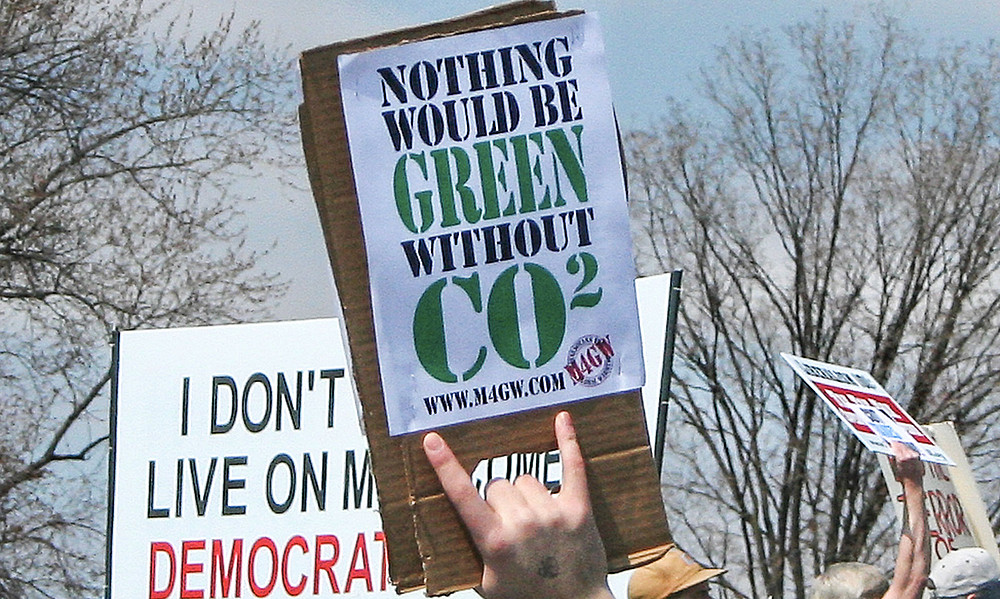
How can it be that people believe there is no climate crisis, when droughts, heatwaves and floods are causing crop failures and disasters with ever-increasing frequency worldwide? A study by the University of Graz highlights how far-right media spread misinformation and conspiracy theories related to climate change, and why many people believe them. A team led by Ilona Otto, a social scientist at the Wegener Center, analysed the communication on the far-right US Telegram channel ‘Midnight Rider’ around the COP29 in 2024. With 210,000 subscribers, the anonymously run channel, which describes itself as a news channel, wields far-reaching influence.
“In our work, we highlight communication strategies that prove extremely effective when used in combination: targeted disinformation in the form of a conspiracy narrative, fault finding with individual representatives of the so-called elites, and the stoking of fear and anger,” summarises Lilli Frei, lead author of the publication. Instead of discussing climate change, the focus is on disparaging individuals. During the period under investigation, one such figure was John Kerry, Special Envoy for Climate Action under President Joe Biden. “The focus was not on his policies, but on his behaviour; the fact that he eats meat and flies to the COP in a private jet. He does what the elites want to forbid us from doing. That makes people angry,” explains the researcher, who is now a PhD student at the Vienna University of Economics and Business (WU).
For her Master’s thesis whilst studying Environmental Systems Sciences at the University of Graz, she had also examined the German-language Telegram channel “AUF1” and found the same strategies there. These are generally typical of communication in far-right media, regardless of the topic. “In this way, the operators reinforce the narrative of the ‘evil elites’ – a small group of influential people in key positions in society who want to control us. This is how far-right extremists pursue their political agenda: they undermine the democratic system and the ideal of an open society based on tolerance and respect,” says Frei.
Publication
Narratives of distrust: climate change, disinformation, and the dynamics of right-wing media
Ilona M. Otto, Lilli Frei, Juyi Kim & Viktoria Kofler
Humanities and Social Sciences Communications (2026)
https://doi.org/10.1057/s41599-026-08597-8
If you are interested in the interconnections between environmental, economic and social issues, you will gain in-depth understanding through the Bachelor’s programme in Environmental Systems Science – Geography at the University of Graz.