Begin of page section:
Page sections:

  • Go to contents (Accesskey 1)
  • Go to position marker (Accesskey 2)
  • Go to main navigation (Accesskey 3)
  • Go to sub navigation (Accesskey 4)
  • Go to additional information (Accesskey 5)
  • Go to page settings (user/language) (Accesskey 8)
  • Go to search (Accesskey 9)

End of this page section. Go to overview of page sections

Begin of page section:
Page settings:

English en
Deutsch de
Search
Login

End of this page section. Go to overview of page sections

Begin of page section:
Search:

Search for details about Uni Graz
Close

End of this page section. Go to overview of page sections


Search

Begin of page section:
Main navigation:

Page navigation:

  • University

    University
    • About the University
    • Organisation
    • Faculties
    • Library
    • Working at University of Graz
    • Campus
    Developing solutions for the world of tomorrow - that is our mission. Our students and our researchers take on the great challenges of society and carry the knowledge out.
  • Research Profile

    Research Profile
    • Our Expertise
    • Research Questions
    • Research Portal
    • Promoting Research
    • Research Transfer
    • Ethics in Research
    Scientific excellence and the courage to break new ground. Research at the University of Graz creates the foundations for making the future worth living.
  • Studies

    Studies
    • Prospective Students
    • Students
    • Welcome Weeks for First Year Students
  • Community

    Community
    • International
    • Location
    • Research and Business
    • Alumni
    The University of Graz is a hub for international research and brings together scientists and business experts. Moreover, it fosters the exchange and cooperation in study and teaching.
  • Spotlight
Topics
  • Sustainable University
  • Researchers answer
  • Work for us
Close menu

End of this page section. Go to overview of page sections

Begin of page section:
You are here:

University of Graz Climate Change news Climate change in the atmosphere
  • About us
  • Research fields
  • Study/Doctorate
  • Network
  • Open Calls

End of this page section. Go to overview of page sections

Friday, 05 November 2021

Climate change in the atmosphere

Long-term temperature trends in the atmosphere can have an impact on large-scale circulation, which determines global climate and weather patterns. Photo: pixabay

Long-term temperature trends in the atmosphere can have an impact on large-scale circulation, which determines global climate and weather patterns. Photo: pixabay

Researchers at the University of Graz clarify causes for the continuous rise of the boundary between the weather layer and the stratosphere

For decades, researchers have been noticing changes in the atmosphere. For example, the troposphere, the weather layer, is becoming increasingly warmer, while the stratosphere above it is cooling. As a result, the boundary between the two layers – the tropopause – is shifting ever higher. Andrea Steiner and Hallgeir Wilhelmsen from the Wegener Center and Doctoral Programme Climate Change at the University of Graz, together with colleagues from China, Canada, the USA and Leo Haimberger from the University of Vienna, have analysed data from 1980 to 2020. The results, published in the scientific journal Science Advances, now prove the extent of the rise of the tropopause. Per decade, this boundary rises by about 50 meters over the Northern Hemisphere. The long-term temperature trends in the atmosphere are linked to the greenhouse gas emissions. Among other things, the structural changes can also have an impact on large-scale circulation that determines global climate and weather patterns.

"As the troposphere warms, it expands, pushing up the boundary with the stratosphere. At the same time, the stratosphere contracts due to its cooling, which further promotes the rise of the tropopause," explains Andrea Steiner, director of the Wegener Center and co-author of the current publication. It is interesting to note that the ratio in which the changes in both layers contribute to the rise in the tropopause has shifted clearly over the observation period: "From 1980 to 2000, the weather layer and the stratosphere each contributed 50 percent to the increase in the tropopause. Since the turn of the millennium, the stronger warming of the weather layer has been responsible for about 80 percent of the increase," Steiner reports. The influence of the stratosphere has decreased to about 20 percent. "This can be explained by its reduced cooling, which in turn must be seen in connection with the regeneration of the ozone layer," adds the atmospheric physicist.

For the current publication, the researchers analysed observational data from radiosondes as well as radio occultation data. The former are carried by weather balloons and cover the Northern Hemisphere well. Radio occultation measurements have only been available continuously since 2001. They are based on GPS signals sent from transmitter to receiver satellites and influenced by temperature and other factors as they travel through the atmosphere. From this, it is possible to derive extremely accurate data on these climate variables in all layers of the atmosphere. Furthermore, it becomes possible to clearly distinguish short-term climate fluctuations caused by natural phenomena from human-induced long-term trends.

Publication
Continuous rise of the tropopause in the Northern Hemisphere over 1980-2020
Lingyun Meng, Jane Liu, David W. Tarasick, William J. Randel, Andrea K. Steiner, Hallgeir Wilhelmsen, Lei Wang, Leopold Haimberger
Science Advances, 7, eabi8065 (2021), Nov. 5.
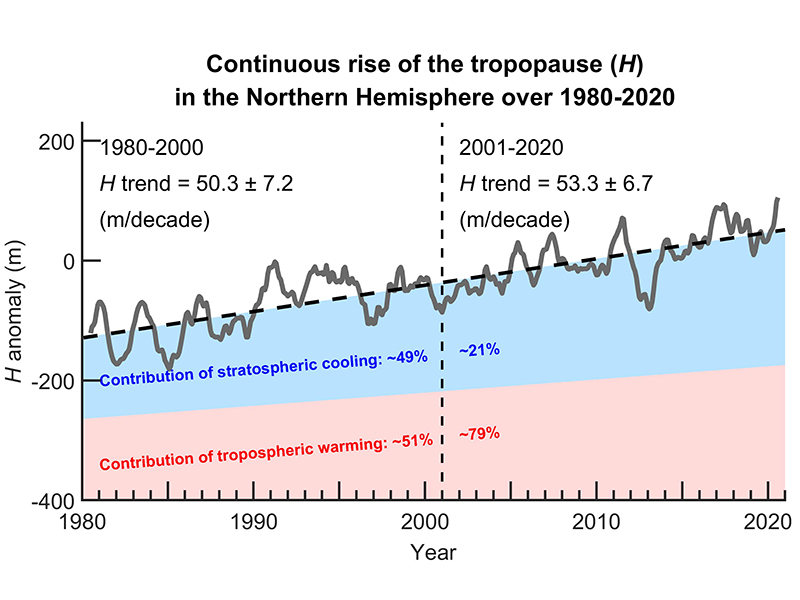
The rise of the tropopause over the Northern Hemisphere from 1980 to 2020 is caused by tropospheric warming and stratospheric cooling. Since the 2000s, it is primarily the increased warming of the troposphere that contributes to the continuous rise. Source: Meng and co-authors 2021
created by Gudrun Pichler

Related news

ACRP - 18. Call: Jetzt klimarelevante Forschung für Österreich einreichen

Das Austrian Climate Research Programme (ACRP) fördert orientierte Grundlagenforschung zu Klimawandel, Anpassung, Minderung und Transformation. Reichen Sie bis 15.04.2026 Ihre Projektidee ein.

2. Österreichischer Hitzeaktionstag (“Austrian Heat Action Day”)

On 9 June 2026, the 2nd Austrian Heat Action Day will take place. The aim of the Heat Action Day is to further strengthen heat protection measures and to sustainably raise awareness of the impacts of climate change on human health.

Reiz-Thema

Die Erde heizt sich auf. Gleichzeitig aber wächst die Zahl derer, die nichts mehr davon hören wollen. Was könnte sie umstimmen? Hermine Mitter untersucht Anreize zu klimafreundlichem Verhalten.

Human Rights, Security and National Adaptation Plans Nexus

A Holistic Approach to Women and Human Mobility on Monday, June 28th 16:00-17:30 online

Begin of page section:
Additional information:

University of Graz
Universitaetsplatz 3
8010 Graz
Austria
  • Contact
  • Web Editors
  • Moodle
  • UNIGRAZonline
  • Imprint
  • Data Protection Declaration
  • Accessibility Declaration
Weatherstation
Uni Graz

End of this page section. Go to overview of page sections

End of this page section. Go to overview of page sections

Begin of page section:

End of this page section. Go to overview of page sections