On average, snow cover in Austria is decreasing significantly, both in terms of depth and duration. At the same time, a massive decline in Austria’s glacier mass is expected by the middle of the century. Both developments have a noticeable impact on the water balance and require precautionary measures. This is the preliminary interim conclusion reached by the Ministry of the Environment’s interdisciplinary research project ‘Water in a Changing Climate – A Study on the Impacts’. Research teams from TU Wien, GeoSphere Austria, the University of Graz and BOKU Vienna are collaborating on the project.
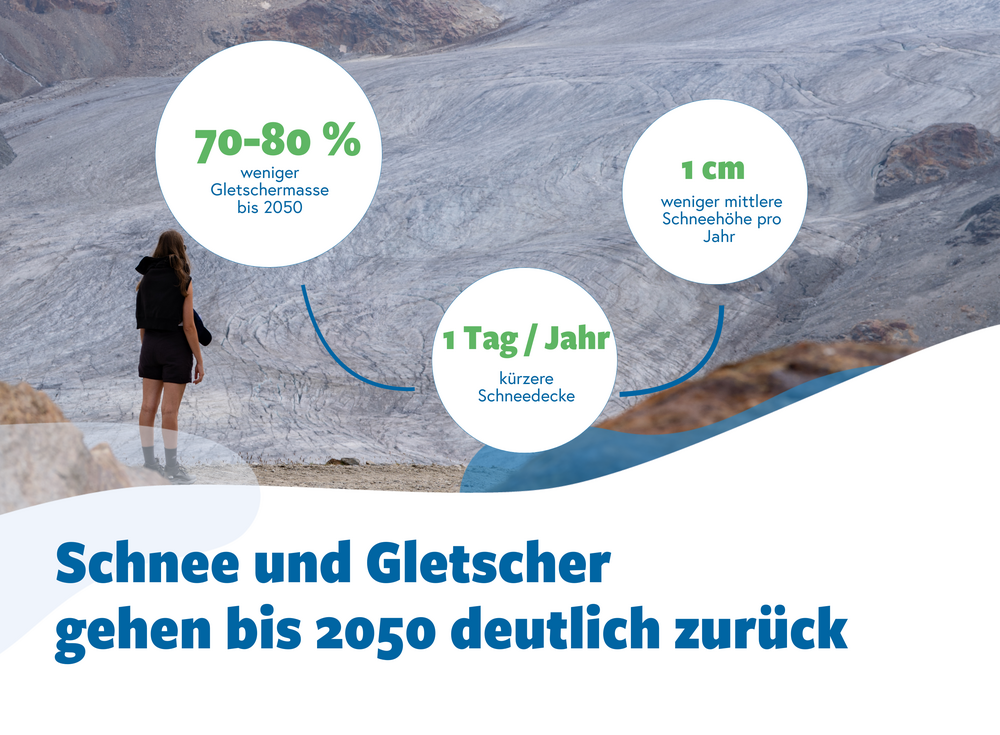
Environment Minister Norbert Totschnig: “According to the findings, the visible changes to glaciers and snow cover will continue. The study helps us understand what consequences this has for our water balance and where we can implement targeted, effective measures. The aim is to secure the supply of this precious resource – water – in the long term.” The study shows a significant decline in snow cover: On average, the duration of snow cover in Austria is decreasing by about one day per year, and the average snow depth is decreasing by around 1 cm per year. This becomes particularly evident when comparing longer time periods: between 1960 and 2020, the duration of snow cover at low altitudes has already decreased by around 60 per cent, and the average snow depth by about 70 per cent.
“The consequences of climate change are particularly evident in the melting of our glaciers and the decline in snow cover. This means further action is needed to secure Austria’s water supply for the future,” says Totschnig. “We have therefore been implementing targeted measures for many years to ensure that every Austrian household can continue to be supplied with sufficient drinking water in the future. The study reinforces this precautionary strategy and provides additional planning certainty for water management, infrastructure and regions.”
Snow cover halved
The decline in snow cover will continue in the future as temperatures rise. This is shown by a snow model developed as part of the study. It calculates changes in snow depth depending on temperature and precipitation trends. From this, it can be deduced that by the middle of the century, the average snow depth at low altitudes (0–500 metres) will decrease by about half compared to today. For mid-altitudes between 500 and 1,000 metres, it will decrease by around 35 per cent. These calculations up to 2050 are based on a probable temperature rise of one degree.
By the year 2100, however, unfavourable scenarios predict a rise of 3 degrees. In this case, snow will be the exception at lower altitudes; at medium altitudes, the snow cover will then decrease by 60 to 75 per cent compared to today. Only above 2,000 to 2,500 metres are the changes significantly smaller.
“Our models show that we will increasingly have to say goodbye to snow, particularly at low altitudes; at medium altitudes, snow cover will decline significantly,” says Prof. Dr Wolfgang Schöner from the Institute of Geography and Spatial Research at the University of Graz, who is conducting research on snow and ice for the study “Water in Climate Change”. “The decline in snow has a direct impact on the water cycle: if snowmelt begins earlier, this alters the seasonal rhythm. Peak runoff occurs earlier; in summer, there tends to be less water available.” The altitude around the zero-degree line is particularly sensitive, as this is where it is determined whether precipitation falls as snow or rain. Since the 1980s, this line has been shifting upwards by 120 to 140 metres every ten years.
Decline in glacier mass
The study also confirms the rapid melting of local glaciers: By 2050, between 70 and 80 per cent of glacier mass will be lost compared to 2024, with the range between the two calculation results arising from the different possible climate scenarios. It is striking that the melting process has already accelerated over the past five years and is progressing more rapidly than researchers had assumed based on previous modelling. How rapidly this decline continues depends on the future trajectory of global warming; based on current knowledge, it can no longer be halted entirely.
Schöner: “Glaciers play a vital role as reservoirs, as they store water and release it during warmer and drier periods. This contribution is decreasing significantly, which will have particular implications in high-alpine catchment areas”. The measurements underpinning the study’s projections on snow and ice are based on a network of around 100 stations across Austria. For the future projections, models are used that combine temperature and precipitation data. For the glaciers, the mass balance is measured directly in the field – including using measuring rods in the ice.
Planning certainty through evidence
The interim results are being incorporated into the research project “Water in a Changing Climate – A Study on the Impacts”, which is being carried out on behalf of the Federal Ministry of Agriculture, Forestry, Climate and Environmental Protection, Regions and Water Management (BMLUK) under the leadership of TU Wien. The climate-induced changes in snow and ice are already the second projection made as part of the study. At the end of January, initial trends regarding the shift of precipitation into the cold season were published. Both projections make it clear that water will be available more unevenly in future.
It is therefore already evident that precautionary measures are becoming more important. If natural reservoirs such as snow and ice become less significant, adaptation measures can mitigate regional shortages: for instance, through greater interconnection of supply systems; through adapted management of reservoirs to make the best possible use of water resources – for example, for energy supply; or through the identification of alternative water sources for infrastructure in high mountain regions that has hitherto relied on glacial water.
The study “Water in Climate Change – A Study on the Impacts” will provide further up-to-date information in the coming months, for example on evaporation, groundwater trends in various regions, high- and low-water scenarios, and water temperatures. The final report will be published at the end of 2026 and will contain detailed forecasts for Austria up to 2100. Further information can be found at wasseraktiv.at/wasser-im-klimawandel