Begin of page section:
Page sections:

  • Go to contents (Accesskey 1)
  • Go to position marker (Accesskey 2)
  • Go to main navigation (Accesskey 3)
  • Go to sub navigation (Accesskey 4)
  • Go to additional information (Accesskey 5)
  • Go to page settings (user/language) (Accesskey 8)
  • Go to search (Accesskey 9)

End of this page section. Go to overview of page sections

Begin of page section:
Page settings:

English en
Deutsch de
Search
Login

End of this page section. Go to overview of page sections

Begin of page section:
Search:

Search for details about Uni Graz
Close

End of this page section. Go to overview of page sections


Search

Begin of page section:
Main navigation:

Page navigation:

  • University

    University
    • About the University
    • Organisation
    • Faculties
    • Library
    • Working at University of Graz
    • Campus
    Developing solutions for the world of tomorrow - that is our mission. Our students and our researchers take on the great challenges of society and carry the knowledge out.
  • Research Profile

    Research Profile
    • Our Expertise
    • Research Questions
    • Research Portal
    • Promoting Research
    • Research Transfer
    • Ethics in Research
    Scientific excellence and the courage to break new ground. Research at the University of Graz creates the foundations for making the future worth living.
  • Studies

    Studies
    • Prospective Students
    • Students
  • Community

    Community
    • International
    • Location
    • Research and Business
    • Alumni
    The University of Graz is a hub for international research and brings together scientists and business experts. Moreover, it fosters the exchange and cooperation in study and teaching.
  • Spotlight
Topics
  • Our digital Advent calendar
  • Sustainable University
  • Researchers answer
  • Work for us
Close menu

End of this page section. Go to overview of page sections

Begin of page section:
You are here:

University of Graz Climate Change news Stickstoff als Schlüssel: überschätzter Effekt von CO2 als Dünger von Pflanzen
  • About us
  • Research fields
  • Study/Doctorate
  • Network
  • Open Calls

End of this page section. Go to overview of page sections

Tuesday, 25 November 2025

Nitrogen as the key: the overestimated effect of CO2 as a plant fertiliser

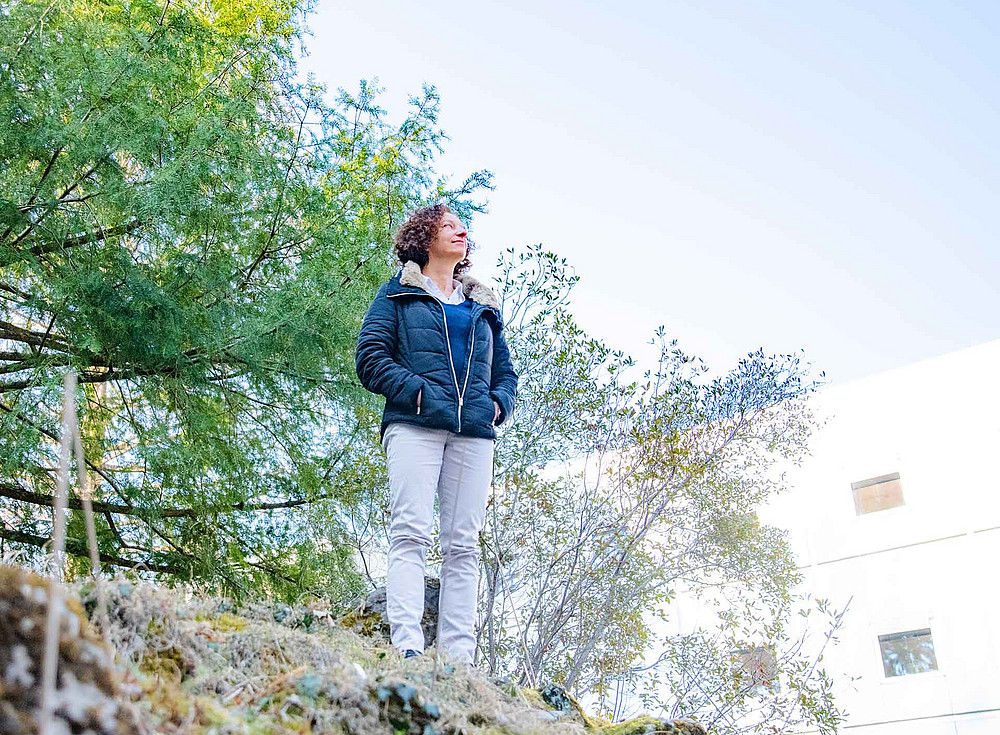
Bettina Weber ©Uni Graz/Tzivanopoulos

Bettina Weber ist Biologin an der Uni Graz und beschäftigt sich mit der biologischen Stickstofffixierung und deren Auswirkung auf den Klimawandel. Foto: Uni Graz/Tzivanopoulos

High levels of atmospheric CO2 can intensify climate change. Having said that, high CO2 also stimulates plant growth which decreases climate change. But only if, among other things, nitrogen is present in sufficient quantities. The actual amount of nitrogen has only recently been reassessed. The “fertilising effect” of CO2 has been significantly overestimated, as a brand-new study involving the University of Graz now shows.

In order to use nitrogen, the element must be fixed in the soil with the help of microorganisms. This biological binding occurs in natural ecosystems, but also on agricultural land. “While this process has been significantly overestimated in nature, it has increased by 75 percent over the past 20 years due to agriculture,” Bettina Weber, biologist at the University of Graz, summarises the findings of a publication from earlier this year.
A new study based on these results now shows that existing calculations on nitrogen fixation in certain Earth System models, which are used, among other things, in the World Climate Report, have been revised. This is the conclusion of the new study, which has been published on 24 November in the scientific journal PNAS.
The publication was led by Sian Kou-Giesbrecht from Simon Fraser University in Burnaby, Canada, as part of a working group on biological nitrogen fixation, of which Bettina Weber is a member. The working group is supported by the U.S. Geological Survey (USGS) John Wesley Powell Centre for Analysis and Synthesis.

“We compared different Earth System models with current nitrogen fixation values and found that they overestimate the nitrogen fixation rate on natural surfaces by about 50 per cent,” Weber explains. Overall, this overestimation of biological nitrogen fixation leads to a reduction in the CO2 fertilisation effect of about 11 per cent.
Weber therefore advocates revising the Earth System models in order to better assess developments. “This is because gases such as nitrogen oxides and nitrous oxide are produced as part of the nitrogen cycle. These can be released into the atmosphere through conversion processes and alter or disrupt climate processes.”

created by Andreas Schweiger

Related news

Reiz-Thema

Die Erde heizt sich auf. Gleichzeitig aber wächst die Zahl derer, die nichts mehr davon hören wollen. Was könnte sie umstimmen? Hermine Mitter untersucht Anreize zu klimafreundlichem Verhalten.

Human Rights, Security and National Adaptation Plans Nexus

A Holistic Approach to Women and Human Mobility on Monday, June 28th 16:00-17:30 online

Circular Bioengineering: FWF Cluster of Excellence aims to revolutionise the product cycle

Take a renewable raw material from nature – wood, for example – break it down into its building blocks and use them to create a functional material, such as a water-repellent surface coating, with the help of green chemistry. Once this has served its purpose, break it down again into its chemical components and use them to build something new. This idea is set to revolutionise the production and life cycle of materials and goods. The Cluster of Excellence "Circular Bioengineering", funded by the Austrian Science Fund FWF, is researching how to produce products from biomass, develop sustainable methods for the production process, and open options for returning products that have reached the end of their lifetime back into a cycle. The University of Graz is a partner in this Cluster of Excellence, for which the FWF is providing 18 million euros. Including its own funds, the total volume of the project is 27 million euros. The lead is with the BOKU University in Vienna.

Climate change update: ClimateTracer of the University of Graz provides reliable data

Yesterday, the Copernicus Climate Change Service of the European Union published its data on global warming up to end of November 2024. These confirm that this year will see the 1.5 °C threshold clearly exceeded for the first time. The Wegener Center at the University of Graz already computed an accurate full-year prediction: the global near-surface air temperature in 2024 will rise by 1.62 °C – plus/minus 0.05 °C standard deviation – compared to the pre-industrial level. Such latest predictions for 2024 and other essential data on climate change are provided by the scientists via the Graz Climate Change Indicators (GCCI) portal.

Begin of page section:
Additional information:

University of Graz
Universitaetsplatz 3
8010 Graz
Austria
  • Contact
  • Web Editors
  • Moodle
  • UNIGRAZonline
  • Imprint
  • Data Protection Declaration
  • Accessibility Declaration
Weatherstation
Uni Graz

End of this page section. Go to overview of page sections

End of this page section. Go to overview of page sections

Begin of page section:

End of this page section. Go to overview of page sections