Begin of page section:
Page sections:

  • Go to contents (Accesskey 1)
  • Go to position marker (Accesskey 2)
  • Go to main navigation (Accesskey 3)
  • Go to sub navigation (Accesskey 4)
  • Go to additional information (Accesskey 5)
  • Go to page settings (user/language) (Accesskey 8)
  • Go to search (Accesskey 9)

End of this page section. Go to overview of page sections

Begin of page section:
Page settings:

English en
Deutsch de
Search
Login

End of this page section. Go to overview of page sections

Begin of page section:
Search:

Search for details about Uni Graz
Close

End of this page section. Go to overview of page sections


Search

Begin of page section:
Main navigation:

Page navigation:

  • University

    University
    • About the University
    • Organisation
    • Faculties
    • Library
    • Working at University of Graz
    • Campus
    Developing solutions for the world of tomorrow - that is our mission. Our students and our researchers take on the great challenges of society and carry the knowledge out.
  • Research Profile

    Research Profile
    • Our Expertise
    • Research Questions
    • Research Portal
    • Promoting Research
    • Research Transfer
    • Ethics in Research
    Scientific excellence and the courage to break new ground. Research at the University of Graz creates the foundations for making the future worth living.
  • Studies

    Studies
    • Prospective Students
    • Students
    • Welcome Weeks for First Year Students
  • Community

    Community
    • International
    • Location
    • Research and Business
    • Alumni
    The University of Graz is a hub for international research and brings together scientists and business experts. Moreover, it fosters the exchange and cooperation in study and teaching.
  • Spotlight
Topics
  • Sustainable University
  • Researchers answer
  • Work for us
Close menu

End of this page section. Go to overview of page sections

Begin of page section:
You are here:

University of Graz Climate Change news Neue Studie zeigt: Ozon-Schicht erholt sich auch über der Antarktis
  • About us
  • Research fields
  • Study/Doctorate
  • Network
  • Open Calls

End of this page section. Go to overview of page sections

Thursday, 07 August 2025

New study shows: Ozone layer recovering over the Antarctic

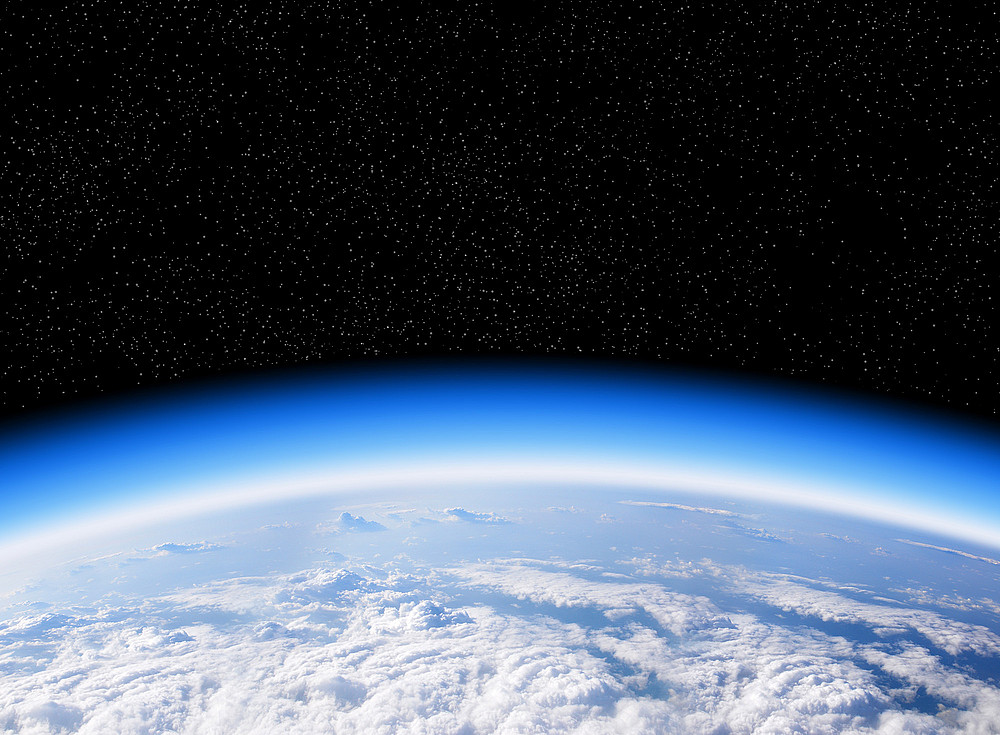
Ozone layer from space view of planet Earth ©studio023 - stock.adobe.com

The ozone layer in the Earth's atmosphere absorbs a large proportion of the sun's UV radiation. Photo: studio023 - stock.adobe.com

Significant temperature changes have been observed in the atmosphere in recent decades. Due to the increase in greenhouse gas concentrations, the troposphere, the weather layer of the atmosphere, is warming, while the stratosphere is cooling above. At the same time, the recovery of the ozone layer is warming the lower stratosphere. The fact that a warming is not observed over the Antarctic raised the question of whether the ozone layer is regenerating less effectively there. An international team of researchers, including a scientist from the University of Graz, has now refuted this theory and found that the cause is instead a slowdown in stratospheric circulation.


With the global ban on chlorofluorocarbons (CFCs) in the late 1980s, the Earth's ozone layer began to slowly recover. By absorbing a large portion of the sun's UV radiation and converting it into heat, it plays also an important role in regulating temperature. As a result, the cooling of the lower stratosphere has stalled since the 2000s, although this trend is only weak over Antarctica. Researchers have now found the cause in a slowdown in the so-called Brewer-Dobson circulation, a large-scale movement of air masses in the atmosphere. “This circulation plays an important role in the global distribution of ozone and other chemical substances,” explains climate researcher Andrea Steiner from the Wegener Centre at the University of Graz. She is one of the authors of a study led by US scientists and published in the journal AGU Advances.

Circulation changes influence temperature in the stratosphere
Most ozone is formed in the tropical stratosphere. Atmospheric circulation transports it further to the polar regions. Changes in the movement of air masses are reflected, among other things, in the temperature of the atmosphere. "Using satellite data from radio occultation measurements from 2020 to 2022, we were able to show that the slowdown in the Brewer-Dobson circulation in the southern hemisphere between October and December led to stronger warming of the southern subtropical lower stratosphere. On the other hand, it is also responsible for the cooling of the lower stratosphere over Antarctica,” reports Steiner. “This effect obscures the recovery of the ozone layer at the South Pole. However, our calculations show that it is indeed present and is only masked by the effects of the circulation change," summarises the scientist.

Publication
Recent Warming of the Southern Hemisphere Subtropical Lower Stratosphere and Antarctic Ozone Healing
Aodhan Sweeney, Qiang Fu, Susan Solomon, Stephen Po-Chedley, William J. Randel, Andrea Steiner, Pu Lin, Thomas Birner, Sean Davis, Peidong Wang
AGU Advances
https://doi.org/10.1029/2025AV001737


empty picture
empty picture
Andrea Steiner, portrait ©© Fotografie Carolin Bohn 2023
© Fotografie Carolin Bohn 2023
Andrea Steiner's research topics comprise atmospheric climate change, its drivers and impacts. Photo: Carolin Bohn
created by Gudrun Pichler

Related news

ACRP - 18. Call: Jetzt klimarelevante Forschung für Österreich einreichen

Das Austrian Climate Research Programme (ACRP) fördert orientierte Grundlagenforschung zu Klimawandel, Anpassung, Minderung und Transformation. Reichen Sie bis 15.04.2026 Ihre Projektidee ein.

2. Österreichischer Hitzeaktionstag (“Austrian Heat Action Day”)

On 9 June 2026, the 2nd Austrian Heat Action Day will take place. The aim of the Heat Action Day is to further strengthen heat protection measures and to sustainably raise awareness of the impacts of climate change on human health.

Reiz-Thema

Die Erde heizt sich auf. Gleichzeitig aber wächst die Zahl derer, die nichts mehr davon hören wollen. Was könnte sie umstimmen? Hermine Mitter untersucht Anreize zu klimafreundlichem Verhalten.

Human Rights, Security and National Adaptation Plans Nexus

A Holistic Approach to Women and Human Mobility on Monday, June 28th 16:00-17:30 online

Begin of page section:
Additional information:

University of Graz
Universitaetsplatz 3
8010 Graz
Austria
  • Contact
  • Web Editors
  • Moodle
  • UNIGRAZonline
  • Imprint
  • Data Protection Declaration
  • Accessibility Declaration
Weatherstation
Uni Graz

End of this page section. Go to overview of page sections

End of this page section. Go to overview of page sections

Begin of page section:

End of this page section. Go to overview of page sections