Begin of page section:
Page sections:

  • Go to contents (Accesskey 1)
  • Go to position marker (Accesskey 2)
  • Go to main navigation (Accesskey 3)
  • Go to sub navigation (Accesskey 4)
  • Go to additional information (Accesskey 5)
  • Go to page settings (user/language) (Accesskey 8)
  • Go to search (Accesskey 9)

End of this page section. Go to overview of page sections

Begin of page section:
Page settings:

English en
Deutsch de
Search
Login

End of this page section. Go to overview of page sections

Begin of page section:
Search:

Search for details about Uni Graz
Close

End of this page section. Go to overview of page sections


Search

Begin of page section:
Main navigation:

Page navigation:

  • University

    University
    • About the University
    • Organisation
    • Faculties
    • Library
    • Working at University of Graz
    • Campus
    Developing solutions for the world of tomorrow - that is our mission. Our students and our researchers take on the great challenges of society and carry the knowledge out.
  • Research Profile

    Research Profile
    • Our Expertise
    • Research Questions
    • Research Portal
    • Promoting Research
    • Research Transfer
    • Ethics in Research
    Scientific excellence and the courage to break new ground. Research at the University of Graz creates the foundations for making the future worth living.
  • Studies

    Studies
    • Prospective Students
    • Students
    • Welcome Weeks for First Year Students
  • Community

    Community
    • International
    • Location
    • Research and Business
    • Alumni
    The University of Graz is a hub for international research and brings together scientists and business experts. Moreover, it fosters the exchange and cooperation in study and teaching.
  • Spotlight
Topics
  • Sustainable University
  • Researchers answer
  • Work for us
Close menu

End of this page section. Go to overview of page sections

Begin of page section:
You are here:

University of Graz Climate Change news Neue bahnbrechende Berechnungsmethode für Klimaextreme
  • About us
  • Research fields
  • Study/Doctorate
  • Network
  • Open Calls

End of this page section. Go to overview of page sections

Monday, 23 February 2026

New groundbreaking computation method for climate extremes

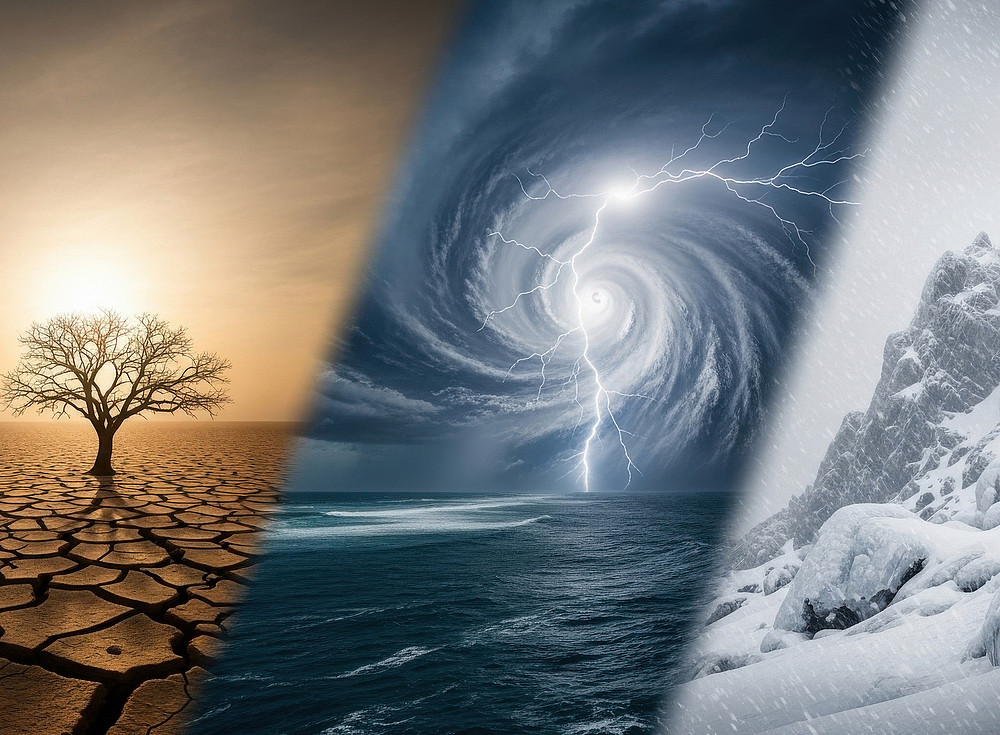
Image composed of three parts: a dried-up tree on cracked earth, storm clouds swirling over the sea, mountains covered in deep snow ©marfuah - stock.adobe.com

Climate extremes have intensified dramatically in recent decades. Image: marfuah - stock.adobe.com, AI generated

How much will heat, flooding, drought and storms increase as a result of human-induced climate change? In a groundbreaking study, climate researcher Gottfried Kirchengast and his team at the University of Graz have developed a new method for computing the hazards from extreme events: it can compute all relevant hazard metrics for events such as heat waves, floods and droughts in any region worldwide with unprecedented information content. Using it for Europe, the researchers found that anthropogenic climate change has caused a tenfold increase in extreme heat in recent decades. The study, published in the journal Weather and Climate Extremes, also provides a basis for better quantifying the damage to people, ecosystems and infrastructure.


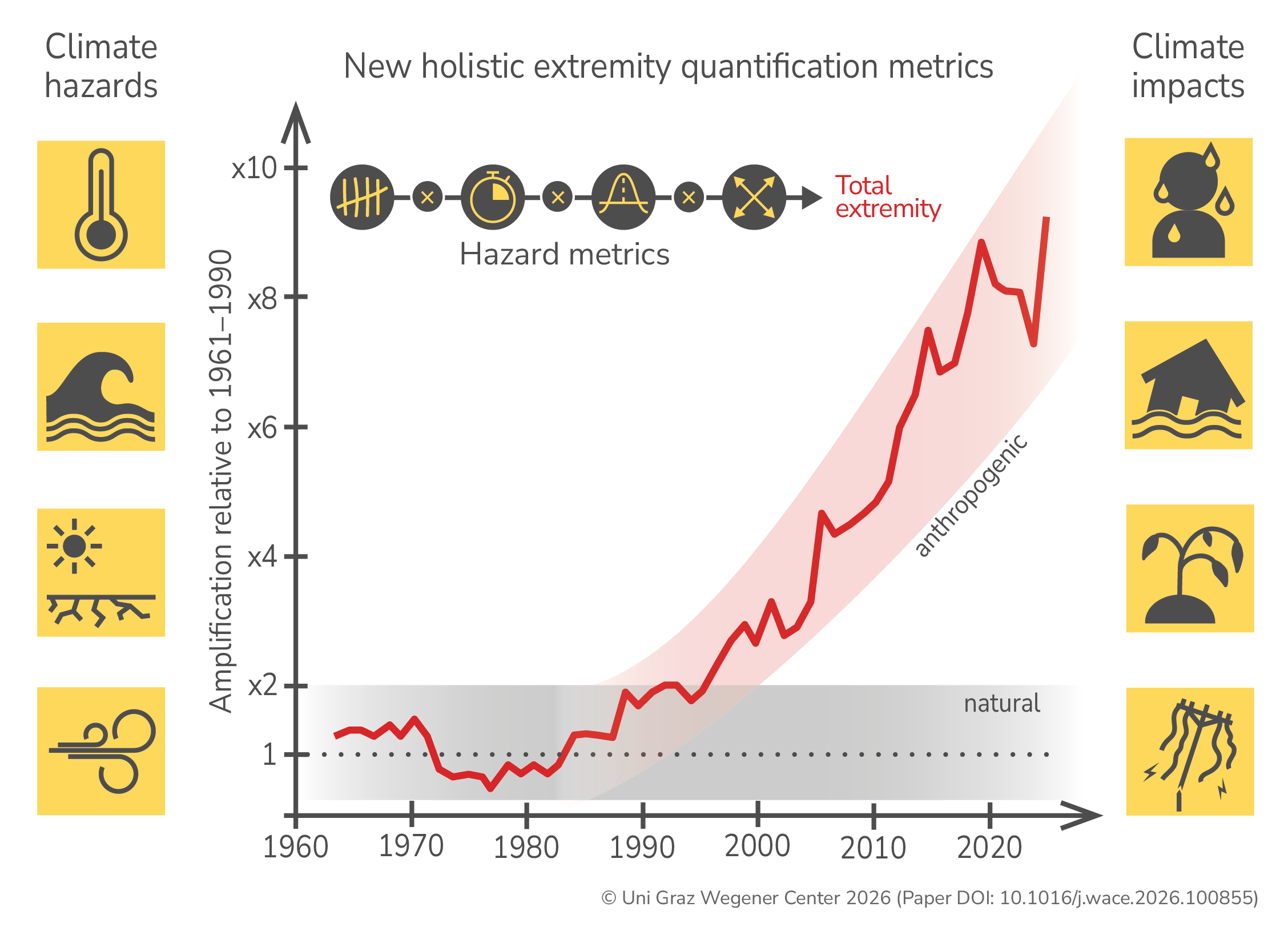
Whether in health, construction, agriculture, forestry or the energy sector, many areas are affected by the impacts and damages caused by weather and climate extremes. For example, temperatures above 30 degrees Celsius put heat stress on the body and weaken the fitness of many people. How well the severity of these hazards can be calculated is, for example, crucial for climate impact computations and corresponding adaptation measures. “Our new, universally applicable method is suitable for all hazard measures defined by the exceedance of critical thresholds. It can be used to compute the frequency, duration, intensity, spatial extent and other variables of extreme events, up to the combination of all metrics in the total extremity,” explains Gottfried Kirchengast from the Wegener Center and Institute of Physics at the University of Graz, main author of the work.

Versatile “Computation tool” for weather and climate extremes
The researcher found a general mathematical solution to the underlying high-dimensional threshold exceedance problem and, together with Stephanie Haas and Jürgen Fuchsberger from the Wegener Center, implemented the method as a widely applicable computation tool. “If suitable long-term climate data are available, the development of climate hazard metrics for extremes of interest can be tracked year by year and decade by decade – in European countries and any other region worldwide,” says Kirchengast, emphasizing the versatility of the method. It can thus serve a wide variety of purposes – from providing comprehensive hazard data on weather extremes for climate impact analyses to supporting attribution of the extent to which emission-intensive actors such as states or companies are responsible for the increasing climate damages and risks. The latter is of great importance in the context of climate lawsuits, among other things.

Extreme heat in Europe increased tenfold due to climate change
In their study, the researchers used the new method to investigate changes in extreme heat events in Austria and across Europe. The computations were based on datasets of daily maximum temperatures over 1961 to 2024. The threshold for “extreme” was taken as the temperature at each location that was exceeded by only one percent of the daily values in the period from 1961 to 1990. For Austria, this threshold value is about 30 degrees, in southern Spain it is over 35 degrees and in Finland it is around 25 degrees.

“We found that the total extremity of heat in Austria and most regions of Central and Southern Europe has increased about tenfold in the current climate period from 2010 to 2024 compared to 1961 to 1990. This has been caused by increases in both the frequency and duration of events, as well as in the threshold exceedance magnitude and spatial extent of the events,” explains Kirchengast, adding: “This massive increase in the total extremity metric goes far beyond its natural variability and shows the influence of human-made climate change with a clarity that even I as a climate researcher have never seen before.”

Publication
Gottfried Kirchengast, Stephanie J. Haas, Jürgen Fuchsberger (2026): A new class of climate hazard metrics and its demonstration: revealing a ten-fold increase of extreme heat over Europe. Weather and Climate Extremes, February 2026. 
Access information for the “Computation tool” can be found in the “Data and software availability” section of the article.
https://doi.org/10.1016/j.wace.2026.100855

The research is part of the Field of Excellence “Climate Change Graz” at the University of Graz.

The new hazard metrics for heat extremes in Austria and Europe, as well as other key data on the development of weather and climate extremes, are freely available and accessible via the Graz Climate Change Indicators – ClimateTracer web portal (as of March 2026 in the data domain “Extremes”). 

Graphic illustrating the new computation method for climate extremes ©University of Graz/Wegener Center
©University of Graz/Wegener Center
To what extent are climate hazards such as heat extremes, flooding, drought and storms (icons at left) intensified by anthropogenic climate change? The study answers this question by introducing a new holistic class of hazard metrics (illustrated by the chart in the middle) that can track the amplification of the extremity of such events, from just frequency change to their total extremity, with a level of rigor not attained before. Based on this diagnostic power, the metrics enable better quantification and attribution of climate impacts, such as quantifying the harm to people, property, ecosystems and infrastructure (icons at right). © University of Graz/Wegener Center
created by Gudrun Pichler

Related news

ACRP - 18. Call: Jetzt klimarelevante Forschung für Österreich einreichen

Das Austrian Climate Research Programme (ACRP) fördert orientierte Grundlagenforschung zu Klimawandel, Anpassung, Minderung und Transformation. Reichen Sie bis 15.04.2026 Ihre Projektidee ein.

2. Österreichischer Hitzeaktionstag (“Austrian Heat Action Day”)

On 9 June 2026, the 2nd Austrian Heat Action Day will take place. The aim of the Heat Action Day is to further strengthen heat protection measures and to sustainably raise awareness of the impacts of climate change on human health.

Reiz-Thema

Die Erde heizt sich auf. Gleichzeitig aber wächst die Zahl derer, die nichts mehr davon hören wollen. Was könnte sie umstimmen? Hermine Mitter untersucht Anreize zu klimafreundlichem Verhalten.

Human Rights, Security and National Adaptation Plans Nexus

A Holistic Approach to Women and Human Mobility on Monday, June 28th 16:00-17:30 online

Begin of page section:
Additional information:

University of Graz
Universitaetsplatz 3
8010 Graz
Austria
  • Contact
  • Web Editors
  • Moodle
  • UNIGRAZonline
  • Imprint
  • Data Protection Declaration
  • Accessibility Declaration
Weatherstation
Uni Graz

End of this page section. Go to overview of page sections

End of this page section. Go to overview of page sections

Begin of page section:

End of this page section. Go to overview of page sections